
Back to News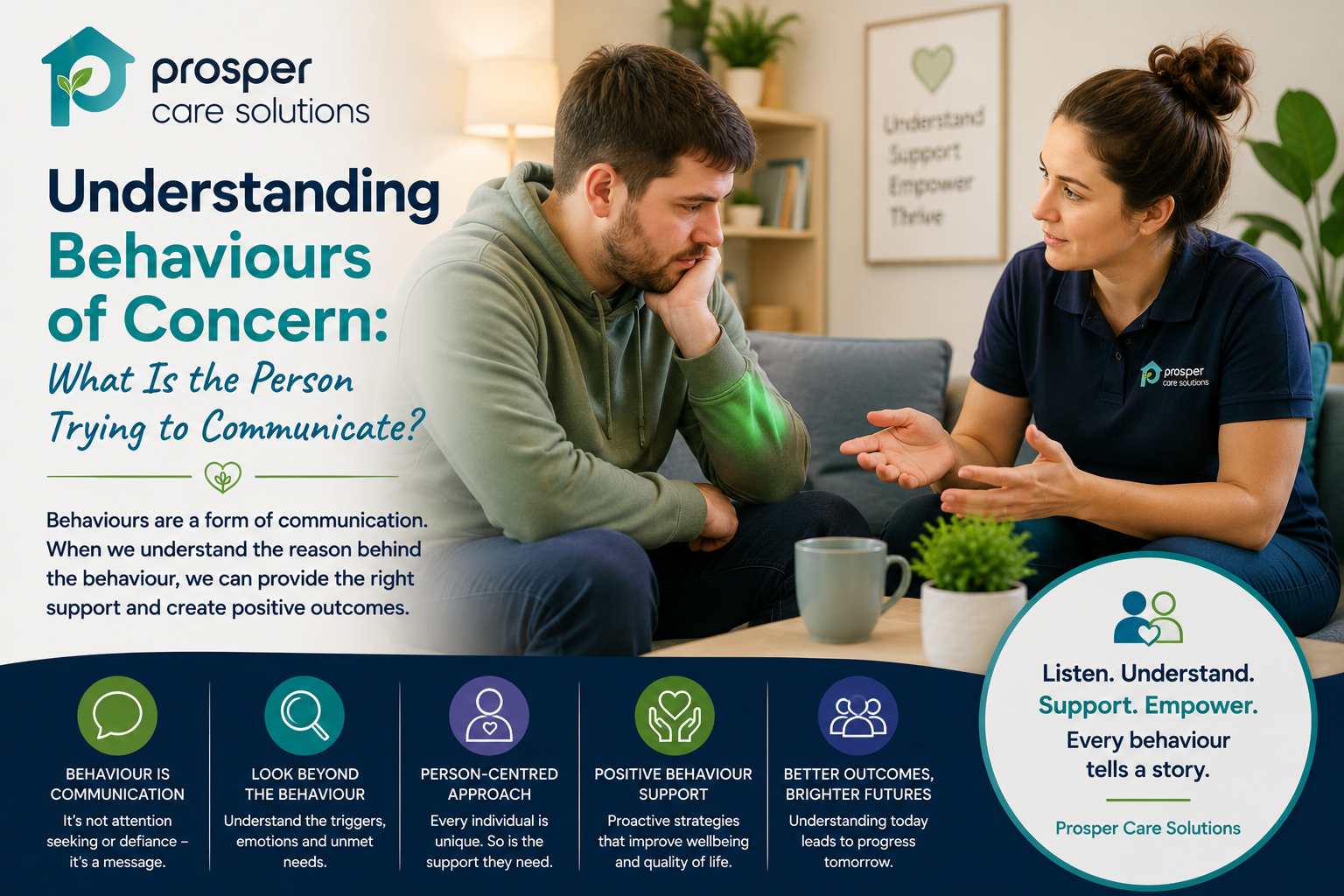
Care Home Activities
Understanding Behaviours of Concern: What Is the Person Trying to Communicate?
5 June 20265 min readCare Home Activities
Behaviours of concern are often a form of communication rather than a problem to be controlled. Discover how Prosper Care Solutions uses Positive Behaviour Support to understand the reasons behind behaviour, identify unmet needs, and create person-centred strategies that improve wellbeing, reduce distress, and help individuals achieve meaningful outcomes.
Introduction
Behaviour is one of the most powerful forms of communication. For individuals with learning disabilities, autism, mental health needs, or complex support requirements, behaviours of concern are often a way of expressing feelings, needs, frustrations, or experiences that may be difficult to communicate in other ways.
Too often, behaviour is viewed as a problem to be managed rather than a message to be understood. At Prosper Care Solutions, we believe that behind every behaviour is a reason, and by understanding that reason, we can provide better support, improve wellbeing, and create positive outcomes.
Rather than asking, "How do we stop this behaviour?" we ask, "What is this person trying to tell us?"
What Are Behaviours of Concern?
Behaviours of concern are actions that may place an individual or others at risk, impact quality of life, or create barriers to participation in everyday activities.
These behaviours can include:
Physical aggression
Verbal aggression
Self-injurious behaviour
Property damage
Social withdrawal
Refusal to engage
Repetitive or distressed behaviours
While the behaviour itself may be challenging, it is important to recognise that it is often a response to an unmet need or underlying difficulty.
Behaviour Is Communication
Every behaviour serves a purpose.
Individuals may communicate through behaviour when they are unable to express themselves effectively through words or other forms of communication.
For example, a person may be:
Experiencing Anxiety
Changes to routine, unfamiliar environments, or uncertainty can cause significant distress.
Feeling Overwhelmed
Sensory sensitivities such as noise, lighting, crowds, or busy environments may become overwhelming.
Struggling to Communicate
The individual may not have the tools or confidence to express what they need.
Experiencing Pain or Discomfort
Physical health conditions, illness, or discomfort may be difficult for the individual to explain.
Seeking Predictability and Control
Unexpected changes can increase stress and lead to behaviours that help the individual regain a sense of control.
Understanding these factors helps us respond with empathy rather than judgement.
Looking Beyond the Behaviour
When we focus only on the behaviour itself, we may miss important information about the individual's experience.
Instead of asking:
"Why is this person behaving this way?"
We should ask:
"What happened before the behaviour?"
"What is the individual experiencing?"
"What need may not be met?"
"What is the behaviour communicating?"
This shift in perspective allows support teams to identify underlying causes and develop effective support strategies.
The Role of Positive Behaviour Support
At Prosper Care Solutions, Positive Behaviour Support (PBS) forms an important part of our approach.
PBS focuses on:
Understanding the reasons behind behaviour
Identifying triggers and patterns
Reducing environmental stressors
Supporting communication
Promoting quality of life
Developing proactive support strategies
The aim is not simply to reduce behaviours of concern but to improve overall wellbeing and help individuals achieve meaningful outcomes.
Building Positive Relationships
Strong relationships are essential when supporting individuals who may display behaviours of concern.
When people feel:
Safe
Understood
Valued
Respected
Listened to
they are more likely to trust those supporting them and engage positively with their environment.
Our teams focus on building genuine, person-centred relationships that provide consistency, reassurance, and emotional security.
Supporting Communication
Many behaviours of concern reduce when individuals have effective ways to communicate their needs.
Support may include:
Visual communication tools
Social stories
Communication aids
Makaton
Clear and consistent language
Personalised communication strategies
Helping individuals express themselves can significantly reduce frustration and improve confidence.
Creating Supportive Environments
The environment can have a major impact on behaviour and wellbeing.
At Prosper Care Solutions, we aim to create environments that:
Promote safety and comfort
Reduce unnecessary stress
Respect sensory needs
Encourage independence
Support emotional wellbeing
By adapting the environment to meet individual needs, we can often reduce triggers and create more positive experiences.
Working in Partnership
Understanding behaviour requires collaboration.
We work closely with:
Families
Local authorities
Healthcare professionals
Psychologists
Speech and language therapists
Multi-disciplinary teams
Partnership working helps ensure that support remains consistent and informed by a comprehensive understanding of the individual.
The Prosper Care Solutions Approach
Our approach focuses on seeing the person behind the behaviour.
We believe that every individual deserves support that is:
Compassionate
Person-centred
Respectful
Proactive
Outcome-focused
By understanding what individuals are trying to communicate, we can help reduce distress, improve quality of life, and create opportunities for growth and independence.
Conclusion
Behaviours of concern are rarely random. They often reflect a person's experiences, emotions, needs, or challenges.
When we take the time to understand what someone is trying to communicate, we move beyond simply managing behaviour and begin supporting the individual in a more meaningful way.
At Prosper Care Solutions, we are committed to understanding the person behind the behaviour, promoting Positive Behaviour Support, and helping individuals achieve happier, healthier, and more fulfilling lives.
Because every behaviour tells a story—and every person deserves to be heard.
About Prosper Care Solutions
Prosper Care Solutions provides high-quality, person-centred residential care and support for adults with learning disabilities, autism, mental health needs, and complex behaviours. Through Positive Behaviour Support and compassionate, individualised care, we empower people to live meaningful lives and achieve positive outcomes.